
Small bathrooms are one of the most common renovation challenges in Melbourne. Period terraces in Fitzroy, Brunswick, and Richmond were often built with bathrooms that are barely 3 square metres. Inner-city apartments in Kew, Doncaster, and Port Melbourne frequently have ensuites that feel more like cupboards than functional rooms. Even newer homes across Ascot Vale, Preston, and Surrey Hills often include a secondary bathroom that was clearly designed as an afterthought.
The good news is that a small bathroom, properly renovated, can deliver a disproportionate improvement to a home's daily quality of life and its market value. The constraints of a compact space force good design decisions. Every fixture, every tile, and every storage choice must earn its place. The result, when the renovation is planned well, is often a bathroom that feels more considered and more polished than a larger room that was designed without the same discipline.
This guide covers everything Melbourne homeowners need to know about small bathroom renovations: layout strategies that maximise the sense of space, tile and colour choices that open up compact rooms, fixture selection for tight footprints, storage solutions that work without taking over, common mistakes to avoid, and what a small bathroom renovation costs in Melbourne.
What Counts as a Small Bathroom?
In Australian residential design, a bathroom under 6 square metres is generally considered small. The minimum bathroom size recommended by most state building codes is approximately 1.8 by 1.5 metres, or 2.7 square metres, which is barely enough to fit a shower, toilet, and small vanity without them touching.
Most small bathroom renovation projects in Melbourne fall into the 3 to 5 square metre range. This is a space that, with poor design, feels cramped and difficult to use. With good design, it can feel efficient, clean, and even generous. The difference almost entirely comes down to layout, fixture selection, and the visual strategies used in tiling and colour.
Ensuites, second bathrooms, and powder rooms often fall into this category. So do many of the original bathrooms in Melbourne's period housing stock, where the bathroom was typically a small, functional room rather than a design feature.
Layout Strategies for Small Bathrooms
The layout of a small bathroom is the most important design decision, and it is the one that is most difficult to change after the renovation is complete. Getting the layout right means understanding which fixtures are essential, how they relate to each other, and how they affect the flow and feel of the room.
Shower Over Bath
In very small bathrooms where a bath is desirable, installing the shower directly over the bath is one of the most space-efficient configurations available. It allows both fixtures to share the same floor area and waterproofed zone, keeping the overall bathroom footprint compact while retaining the option for a bath soak.
This configuration is particularly common in family homes where the main bathroom needs to serve children who use a bath and adults who prefer a shower. It is also a practical solution in period Melbourne homes where the original bathroom was designed around a bath and a separate shower is not feasible within the existing footprint.
Wet Room
A wet room removes the shower enclosure entirely and waterproofs the entire bathroom floor and walls, allowing the shower to operate without a screen or frame. This approach dramatically reduces the visual clutter in a small bathroom and makes the space feel larger because there is no glass or frame interrupting the sight lines.
Wet rooms require comprehensive waterproofing to AS 3740 and a carefully considered drainage layout to ensure water is directed efficiently toward the drain. They work best in bathrooms with a single external window or good mechanical ventilation, as moisture management is important in a fully open shower configuration. They are a popular small bathroom design choice in Melbourne's contemporary and minimal bathroom renovations.
Floating Fixtures
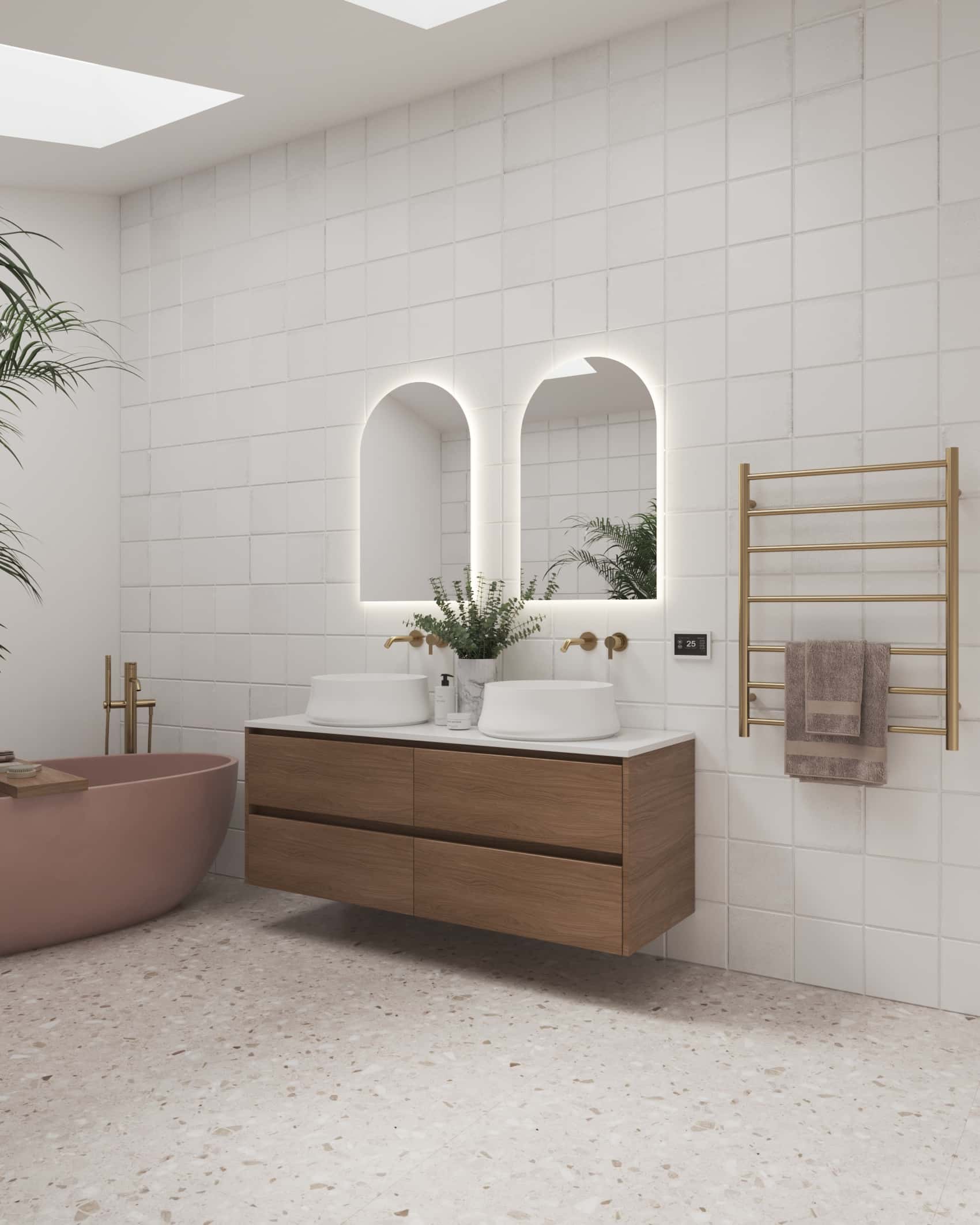
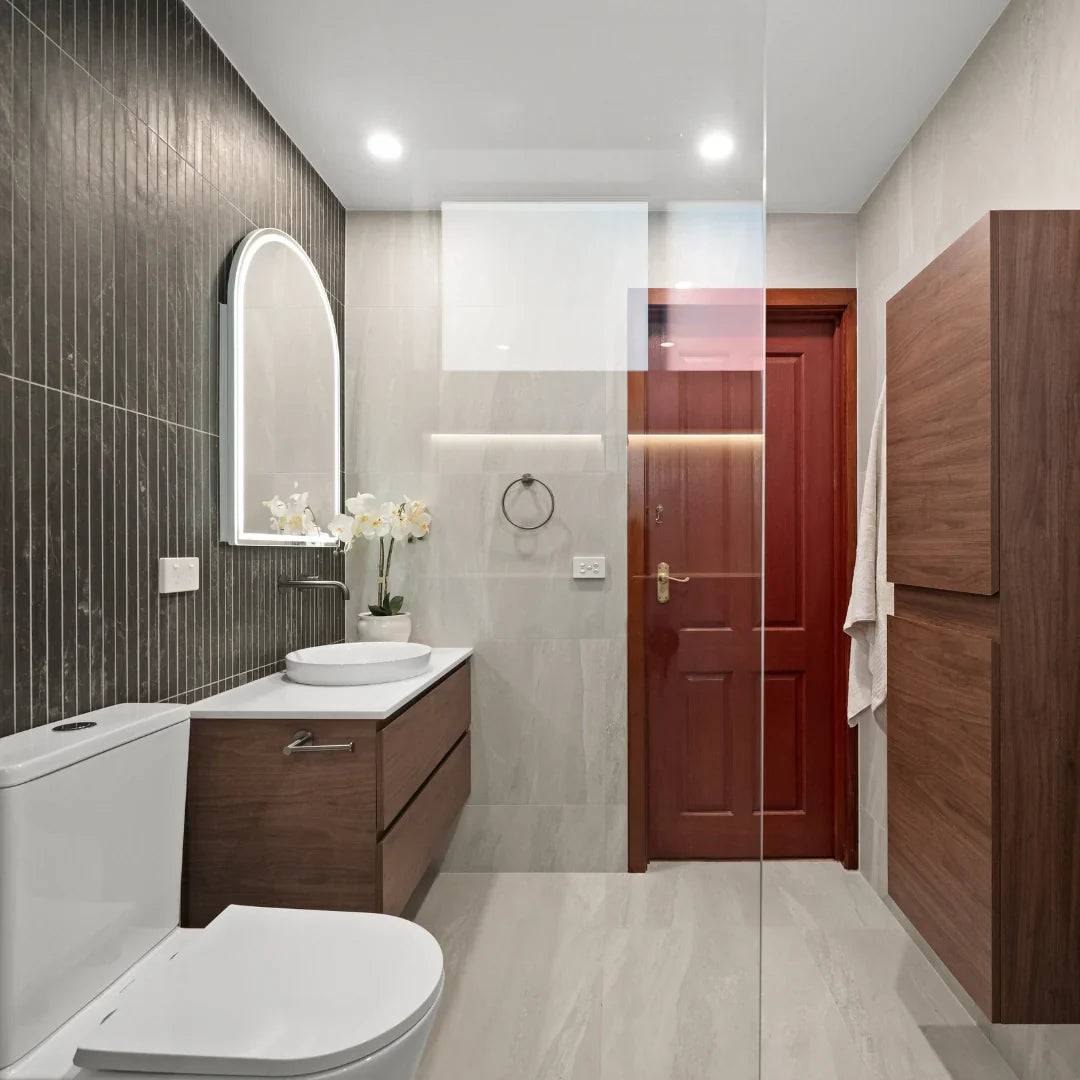
Floating vanities and wall-hung toilets are among the most effective space-expanding strategies available in a small bathroom renovation. Both fixtures are mounted directly to the wall rather than sitting on the floor, which reveals the floor surface beneath them and creates a visual impression of more floor space than actually exists.
Wall-hung toilets also make cleaning the floor significantly easier, which is a practical benefit that compounds over the life of the bathroom. They require a in-wall cistern system, which adds modestly to the cost but produces a cleaner, more contemporary aesthetic.
Floating vanities with a drawer configuration beneath provide usable storage while keeping the visual floor space open. Even a 400mm or 450mm wide floating vanity provides adequate basin space and meaningful drawer storage in a small bathroom where a full-width vanity would dominate the room.
Corner Showers
In rooms where space is especially tight and a full-width shower is not feasible, a corner shower positions the shower in one corner of the room and uses the two adjacent walls as its primary surfaces, requiring only a single screen or door on the open side. This is one of the most efficient small bathroom design ideas for L-shaped or square rooms where the shower must coexist with a separate toilet and vanity without the room feeling overcrowded.
Pocket Doors and Barn Doors
In a small bathroom, a standard swing door consumes significant floor area as it opens. A pocket door that slides into the wall requires no floor clearance at all. A barn door that slides along the external wall face requires no floor space inside the bathroom. Either option can recover 0.5 to 1 square metre of usable floor space in a small bathroom, which is proportionally significant in a 3 to 4 square metre room.
Tile and Colour Strategies That Make Small Bathrooms Feel Larger
The visual perception of space in a small bathroom is significantly affected by the choices made in tiling and colour. Several strategies consistently make compact bathrooms feel larger and more open.
Large Format Tiles
Counter-intuitively, larger tiles make small bathrooms feel bigger, not smaller. The fewer grout lines visible in a tiled space, the less the eye is interrupted and the more continuous the surface appears. Large format tiles of 600 by 600mm or 600 by 1200mm are among the most popular bathroom design ideas in Melbourne precisely because of this effect.
Large format tiles also look more current and premium than small mosaic or standard 300mm tiles, which means they contribute to the bathroom's perceived quality as well as its perceived size.
Consistent Tile Throughout
Using the same tile on both the floor and the walls of a small bathroom removes the horizontal line that typically separates floor and wall surfaces. Without that line, the bathroom reads as a continuous surface rather than two separate planes, and the room appears taller and more expansive. This approach is particularly effective in wet rooms and in small ensuites where the ceiling is lower than standard.
Light Colours and Neutral Palettes
Light colours reflect natural and artificial light and make surfaces appear to recede, both of which contribute to a sense of space in a small room. Whites, warm creams, soft greys, and pale stone tones are consistently among the most popular small bathroom renovation ideas in Melbourne because they deliver a spacious, fresh result that also ages well.
This does not mean small bathrooms must be entirely neutral. A dark or textured feature wall behind the vanity or along one tiled surface adds depth and character without visually compressing the space. The key is to keep the dominant surfaces light and introduce contrast selectively.
Mirrors and Reflective Surfaces
A full-width mirror above the vanity visually doubles the depth of a small bathroom by reflecting the opposite wall. In a 1.5 metre wide bathroom, a full-width mirror creates the impression of 3 metres of depth. This is one of the simplest and most cost-effective strategies available in a small bathroom renovation, and it also improves the practical functionality of the bathroom for grooming and preparation.
Frameless mirrors, mirror cabinets that also provide storage, and mirrored splashbacks above the vanity all deliver the same effect at different price points.
Fixture Selection for Small Bathrooms
In a small bathroom, every fixture must be selected with its footprint in mind. Standard Australian bathroom fixtures are typically designed for rooms of average size and above. Several compact or slimline alternatives are specifically engineered for smaller spaces.
- Compact toilets: Standard Australian toilet suites have a floor footprint of approximately 700 to 750mm front to back. Compact or slimline suites reduce this to 620 to 650mm, recovering 80 to 100mm of floor depth in a tight bathroom.
- Slimline vanities: Vanities as shallow as 300 to 350mm are available, compared to the standard 460 to 500mm depth, freeing meaningful floor space in rooms where every centimetre counts.
- Shower bases: Compact square shower bases in 800 by 800mm or 900 by 900mm are standard small bathroom renovation choices. Linear shower drains eliminate the need for a raised base and allow a flush floor transition, which is both visually cleaner and safer.
- Combination bath-shower units: In rooms where a separate shower and bath are desired but space does not allow both independently, a bath with a shower screen over it is the most practical solution.
- Integrated storage: Recessed niches built into the shower wall during the tiling phase provide shelf space without protruding into the shower area. They are one of the most functional and popular small bathroom design ideas used in Melbourne renovations.
Storage Solutions for Compact Bathrooms
Storage is one of the most challenging aspects of a small bathroom renovation, and it is the area where thoughtful design makes the greatest difference to daily usability.
- Mirror cabinets: A mirrored cabinet above the vanity combines the visual benefit of a large mirror with practical storage for everyday items behind the mirror face. In a small bathroom, this is often the most efficient single storage decision available.
- Floating vanity with drawers: A drawer configuration in a floating vanity provides significantly more usable storage than a traditional cupboard below the basin, because drawers allow full access to their contents without reaching to the back of a dark shelf.
- Recessed shower niches: Built into the shower wall during tiling, recessed niches provide shampoo and soap storage without taking any floor or wall depth from the shower area. One or two well-placed niches eliminate the need for shower caddies that clutter small shower spaces.
- Tall boy cabinets: In bathrooms where floor space allows a narrow tall unit, a tall boy provides significant vertical storage for towels, toiletries, and cleaning supplies in a compact horizontal footprint.
- Wall-mounted towel rails: Floor-standing towel rails consume floor space that small bathrooms cannot spare. Wall-mounted heated towel rails provide both function and warmth without any floor footprint.
Small Bathroom Renovation Costs in Melbourne
Small bathroom renovations in Melbourne are among the most cost-efficient renovation investments available, because the labour and material costs are proportional to the room size. The cost per square metre of a small bathroom renovation is similar to that of a larger bathroom, but the overall total is lower because less material and less labour time are required.
|
Project type |
Typical size |
Estimated cost (Melbourne) |
|
Basic small bathroom refresh |
Under 4sqm |
$8,000 to $12,000 |
|
Mid-range small bathroom renovation |
3 to 6sqm |
$12,000 to $18,000 |
|
Premium small bathroom renovation |
3 to 6sqm |
$18,000 to $25,000 |
|
Small ensuite renovation |
2 to 4sqm |
$8,000 to $16,000 |
|
Wet room conversion |
2 to 4sqm |
$10,000 to $20,000 |
The main variables that affect the cost of a small bathroom renovation in Melbourne are the quality of fixtures and materials selected, whether waterproofing repairs or plumbing adjustments are needed, and whether any layout changes are involved. A like-for-like tile and fixture replacement with no layout changes is at the lower end of the cost range. A renovation that includes layout changes, premium materials, or structural repairs will be at the higher end.
Small Bathroom Renovations Across Melbourne Suburbs
Small bathroom renovation challenges are not uniform across Melbourne. They reflect the housing stock and typical property types in each suburb.
In Brunswick and Fitzroy, the primary small bathroom renovation context is the original bathroom in a Victorian or Edwardian terrace: a long, narrow room that often includes both a bath and a separate toilet accessed from a different door. These bathrooms benefit most from wet room configurations, wall-hung fittings, and large format tiles that visually expand the narrow floor plan.
In Preston and Doncaster, the typical small bathroom renovation is in a 1960s or 1970s brick home where the bathroom is a separate room from the toilet and has a standard but dated layout. These renovations most often involve a full fixture replacement, re-tiling throughout, and a floating vanity to update the look without changing the layout.
In Kew and Hawthorn, many of the small bathroom renovations are ensuites created during earlier renovations of period homes, often in spaces that were not originally designed as bathrooms. These tend to be the most constrained in terms of floor area and the most reliant on smart fixture selection and tile strategy to feel generous despite their size.
In Ascot Vale and Port Melbourne, a mix of period homes and apartment buildings creates demand for small bathroom renovations across a range of footprints, from genuinely compact apartment bathrooms to the proportionally modest bathrooms of interwar homes.
Common Small Bathroom Renovation Mistakes to Avoid
- Standard Australian bathroom fixtures are sized for average or above-average rooms. In a small bathroom, these fixtures can occupy disproportionate floor space. Always check the dimensions of every fixture against the available floor plan before purchasing.Choosing fixtures designed for larger rooms.
- Smaller tiles create more grout lines, which fragment the surface and make the room feel smaller. Counter-intuitively, large format tiles are almost always the better choice in a small bathroom.Using small tiles to fill a small room.
- A standard swing door in a small bathroom consumes a significant arc of floor space as it opens. Pocket doors or barn-style sliding doors recover that space for use.Installing a standard swing door.
- Wet rooms require excellent ventilation because the entire room surface is exposed to moisture. Inadequate ventilation in a wet room creates mould problems that damage finishes and affect air quality. Specify a quality exhaust fan with adequate capacity for the room volume.Ignoring ventilation in a wet room.
- In a small bathroom, poor lighting makes the room feel smaller, darker, and less inviting. Layered lighting that combines a primary ceiling fixture with task lighting at the vanity level transforms how a compact bathroom feels, particularly in the morning and evening when natural light is limited.Underestimating the importance of lighting.
- The cost of waterproofing a small bathroom is proportionally modest relative to the total renovation cost, but the cost of remediating poor waterproofing is substantial. Full compliance with AS 3740 is non-negotiable regardless of room size.Skimping on waterproofing.
Frequently Asked Questions
What is the minimum size for a bathroom renovation in Melbourne?
The minimum recommended bathroom size in Australian residential construction is approximately 2.7 square metres, or 1.8 by 1.5 metres. This is enough to fit a shower, toilet, and small vanity, though the result will be very compact. Most small bathroom renovations in Melbourne work with rooms between 3 and 6 square metres, which allows for a more comfortable configuration and better storage options.
How much does a small bathroom renovation cost in Melbourne?
A small bathroom renovation in Melbourne typically costs between $8,000 and $25,000 depending on the scope of work and the quality of materials and fixtures selected. A basic refresh with standard fixtures and tiles costs from $8,000 to $12,000. A mid-range renovation with quality finishes and a floating vanity costs $12,000 to $18,000. A premium small bathroom renovation with designer fixtures, large format tiles, and custom features costs $18,000 to $25,000.
What are the best small bathroom ideas for Melbourne homes?
The most effective small bathroom design ideas for Melbourne homes include using large format tiles to minimise grout lines and expand the visual space, installing a floating vanity and wall-hung toilet to reveal more floor area, fitting a recessed shower niche for storage without protrusion, using a full-width mirror to visually double the room's apparent depth, and choosing a light, neutral tile palette as the dominant surface. A wet room configuration is also highly effective in the most compact spaces.
Can I add a bath to a small bathroom?
Yes, in many cases. A bath over shower configuration uses the bath footprint for both functions and is one of the most practical small bathroom ideas for households that want both. Compact freestanding baths and Japanese-style soaking tubs are also available in smaller footprints than standard baths and can fit in rooms that would not accommodate a full-length Australian bath.
How long does a small bathroom renovation take in Melbourne?
Most small bathroom renovations in Melbourne take between two and four weeks from the start of demolition to completion. The compact size of the room means fewer tiles, less labour, and shorter construction sequences than a larger bathroom. The planning and selections phase before work begins typically adds two to four weeks.
Is it worth renovating a small bathroom before selling?
Yes. Updated bathrooms are among the strongest renovation investments before a property sale in Melbourne. A well-executed small bathroom renovation removes a common buyer objection and allows the property to compete on presentation. The cost of a small bathroom renovation is proportionally modest compared to the total property value in most Melbourne suburbs, and the return in terms of buyer perception and final sale price is consistently strong.
Talk to APD Design About Your Small Bathroom Renovation
APD Design specialises in small bathroom renovations across Melbourne, including ensuites, second bathrooms, and the original bathrooms in period homes that need a complete design rethink. We work with homeowners across Brunswick, Kew, Preston, Ascot Vale, Port Melbourne, Hawthorn, and throughout greater Melbourne to design and deliver compact bathroom renovations that maximise every available centimetre.
Book a free consultation with our team to discuss your small bathroom, see examples of our completed work, and get a clear picture of what your renovation will cost before any work begins.

Leave a comment
This site is protected by hCaptcha and the hCaptcha Privacy Policy and Terms of Service apply.