
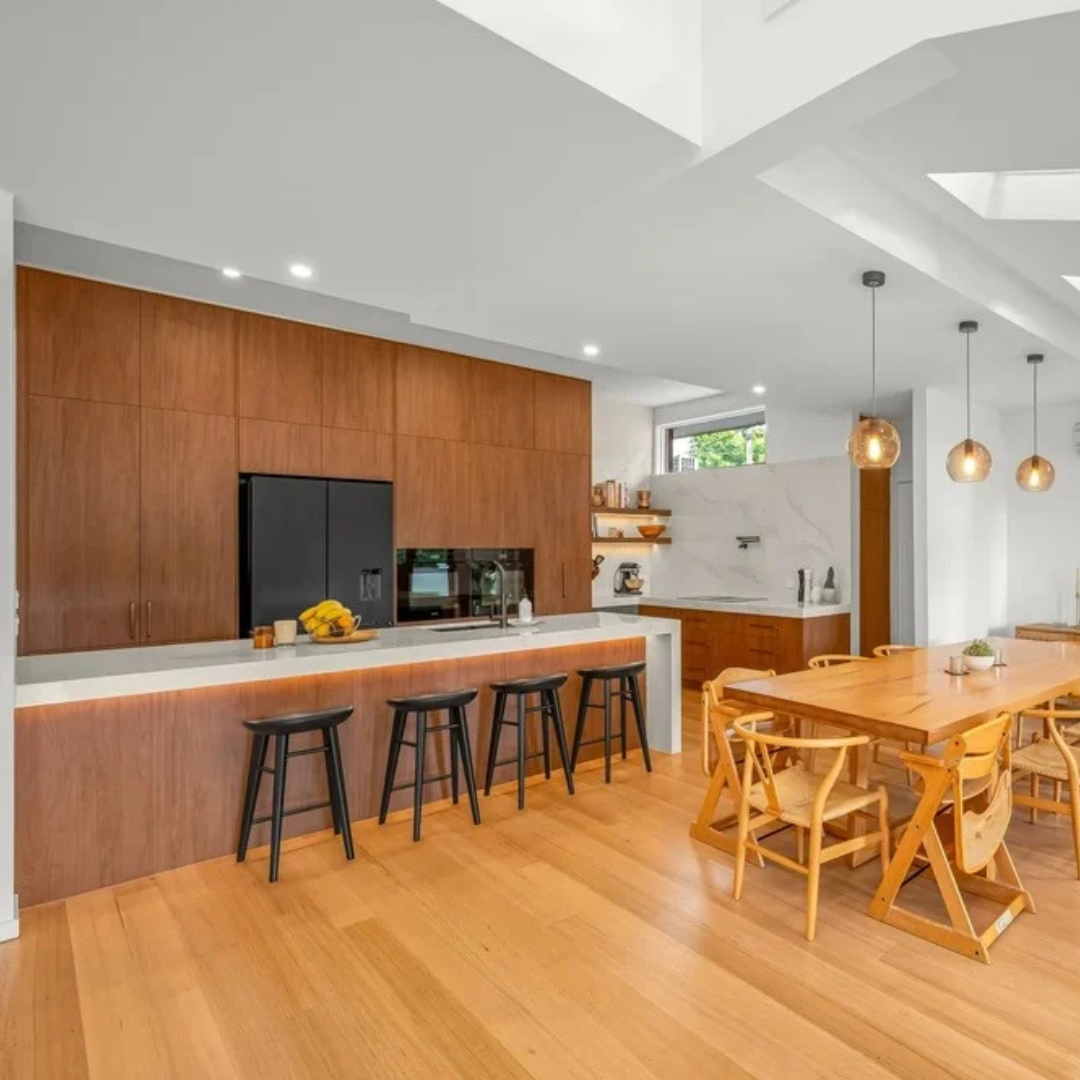
A kitchen does not need to be one colour to feel put together. Two-tone kitchens, where the lower cabinets are one finish and the upper cabinets are another, have become one of the most popular ways to add warmth and depth without making a kitchen feel busy. One of the most reliable pairings is a timber-look lower cabinet with a white upper cabinet, and it is easy to see why so many homeowners keep choosing it.
In This Article
- What a two-tone kitchen is
- Why timber lowers and white uppers work so well
- Choosing the right timber tone
- Getting the balance right
- Two-tone combinations at a glance
- A real example from a Frankston kitchen
- How to test a pairing before you commit
- Common mistakes to avoid
- Frequently asked questions
What Is a Two-Tone Kitchen
A two-tone kitchen uses two different colours or finishes across the cabinetry, most often splitting the lower cabinets from the upper cabinets. This gives the eye two clear, deliberate surfaces to read, rather than one flat block of colour running from floor to ceiling. The same idea can also be used between an island and the surrounding perimeter cabinetry, which is worth keeping in mind if your kitchen has an island bench.
Two-Tone Versus a Single Colour Kitchen
A single colour kitchen uses one finish across every cabinet, which can look clean but sometimes feels flat in a larger room. A two-tone kitchen keeps that same sense of order, since there are still only two finishes in total, but adds contrast and depth by splitting them across the upper and lower cabinetry. This is different again from a kitchen with several unrelated finishes, which tends to feel busy rather than considered.
Why Timber Lowers and White Uppers Work So Well
- Grounding effect: timber lowers sit close to the floor and give the kitchen a sense of weight and warmth, similar to timber flooring or furniture elsewhere in the home.
- Keeps the room feeling light: white uppers reflect more light than a dark or heavily grained finish, so the kitchen still feels open, which matters if the upper cabinets sit close to a window or ceiling.
- A practical choice: lower cabinets take more daily wear from bumps, spills and general use, and a timber-look finish tends to hide marks better than a plain white surface in the same spot.
- Suits almost any kitchen style: the same pairing works in modern, Hamptons and contemporary Melbourne homes, since the ratio of timber to white can lean more traditional or more minimal depending on the rest of the room.
Design Tip: Bring a sample of your chosen timber finish home and view it in your own kitchen at different times of day. Timber tones can look noticeably warmer under evening light than they do in natural daylight.
Choosing the Right Timber Tone
Not all timber-look finishes read the same way. It is worth matching or at least coordinating the undertone of your timber cabinetry with your flooring, so the two do not compete with each other across the room.
| Timber Tone | Mood It Creates | Pairs Well With |
|---|---|---|
| Light oak or whitewashed timber | Relaxed, casual, Scandinavian | Light flooring, white or soft grey walls |
| Warm honey or golden timber | Traditional, inviting, classic Hamptons | Warm white uppers, brass or brushed gold hardware |
| Rich walnut or dark timber | Bold, sophisticated, contemporary | Crisp white uppers, matte black or chrome hardware |
Getting the Balance Right
A simple rule of thumb is to let the lower cabinets and island carry the stronger tone, timber in this case, while the upper cabinets and walls stay lighter. This keeps the top half of the room feeling open rather than heavy.
How Much Timber Is Too Much
There is no fixed ratio that works for every kitchen, since it depends on the size of the room, the amount of natural light, and how much upper cabinetry the layout actually needs. As a general guide, once timber cabinetry starts creeping above the benchtop line and onto upper cabinets as well, the room starts to feel heavier rather than balanced. Viewing a full sized sample board in the room itself, rather than judging from a small swatch, is the most reliable way to check the balance before committing.
It is also worth resisting the urge to add a third or fourth competing finish once the two main tones are set. A two-tone kitchen works because there are two dominant tones, not several. Where hardware is used, keeping it to one consistent finish across both cabinet tones helps the kitchen read as a single, considered design rather than two separate kitchens pushed together.
Two-Tone Combinations at a Glance
Timber and white is not the only pairing worth exploring. A few other combinations that work well in Melbourne homes include:
| Combination | Style Achieved | Best For |
|---|---|---|
| Timber-look lower, white upper | Warm, balanced, widely liked | Most home styles |
| Charcoal or matte black lower, white upper | Bold, contemporary | Modern and minimalist homes |
| Sage or muted green lower, white upper | Soft, coastal | Light filled, casual homes |
| Two timber tones, dark island and lighter perimeter | Layered, textural | Open plan kitchens with a feature island |
A Real Example: A Frankston Kitchen
A recent Frankston kitchen combined a timber-look laminate finish across the lower cabinetry with simple white overhead cabinets above. Handleless, finger-pull cabinetry was used across both tones, so the look stayed clean without visible hardware breaking up either finish. A continuous porcelain benchtop and splashback then tied the two tones together, without adding a third material into the mix.
How to Test a Two-Tone Pairing Before You Commit
- View large sample boards in the kitchen itself, rather than judging from small swatches at a showroom.
- Check the pairing in natural daylight and again under your kitchen's evening lighting, since timber tones especially can shift noticeably between the two.
- Look at the timber and white samples alongside your flooring and benchtop samples together, not in isolation from each other.
- Live with the samples in the room for a few days before finalising, since first impressions under showroom lighting can differ from how they read at home.
Common Mistakes to Avoid
- Choosing the two tones separately, rather than viewing them side by side before deciding.
- Mismatching warm and cool undertones between the timber cabinetry and the flooring.
- Adding a third or fourth competing finish once two tones are already set.
- Using different hardware finishes across the two cabinet tones instead of one consistent finish.
- Overlooking how the benchtop and splashback will bridge, or clash with, the two tones.
Frequently Asked Questions
Q. Do two-tone kitchens suit small kitchens as well as large ones?
Yes, although in a small kitchen it usually works best to keep the darker or stronger tone to the lower cabinets and island only, and keep the upper cabinets and walls light, so the room does not feel closed in.
Q. Is a two-tone kitchen more expensive than a single colour kitchen?
Not necessarily. Cost comes down to the cabinetry material and finish chosen for each tone, not the fact that there are two of them, so a two-tone kitchen can sit at a similar price point to a single colour kitchen using the same materials.
Q. Should the benchtop match the upper or lower cabinets?
There is no fixed rule, but a benchtop in a neutral tone, such as white, grey or a warm stone look, generally works well as a bridge between a timber lower and a white upper, without competing with either.
Q. Will a two-tone kitchen date quickly?
A well balanced pairing like timber and white has stayed popular for a long time because it is a fairly neutral combination, so it is less likely to feel dated quickly compared with a bold colour pairing.
Q. Can I use a two-tone approach with an island kitchen?
Yes, this is one of the most popular ways to use the idea. The island can carry a stronger or contrasting tone while the surrounding perimeter cabinetry stays lighter, or the other way around, depending on the look you want.
Q. Do the cabinet doors need to be the same style across both tones?
It is not essential, but keeping the same door profile, such as handleless or shaker, across both tones usually gives a more considered result than mixing profiles as well as colours.
Final Thoughts
A two-tone kitchen is one of the simplest ways to add warmth and depth without overcomplicating the design. Getting the balance right, choosing one dominant timber tone, keeping the upper half of the room light, and carrying hardware and benchtop choices through consistently, is what separates a two-tone kitchen that feels considered from one that feels mismatched.
If you are planning a new kitchen and want to explore timber and white, or another two-tone pairing, for your own home, get in touch with our kitchen design team.


Leave a comment
This site is protected by hCaptcha and the hCaptcha Privacy Policy and Terms of Service apply.